By Paul Vieira, Financial Post
June 25, 2009
OTTAWA — Former deputy prime minister John Manley will take over as the chief lobbyist for Canada's blue-chip chief executives, starting in January of next year.
Manley was named Thursday as the incoming CEO of the Canadian Council of Chief Executives, succeeding long-time head Thomas d'Aquino who is leaving after nearly two decades on the job.
Manley will officially join CCCE on Oct. 19 as president-designate in order to ensure a smooth transition, according to a statement from the organization.
"(Manley's) outstanding record of leadership in the public and private sectors, his passion for public policy, his stature as statesman at home and abroad and his well-deserved reputation for integrity make him a perfect fit as our Council's next leader," said Gordon Nixon, Royal Bank of Canada's CEO and the CEO council's chairman of the board. "The council's board of Directors is delighted that he has agreed to take on this extraordinary challenge."
For his part, d'Aquino said he "warmly" welcomed Manley's hiring, adding: "I am confident that under his leadership, and with the continued support of our members and of our highly capable and loyal staff, the council's future will be marked by excellence and innovation."
Manley held a number of senior cabinet posts in the Liberal government led by former prime minister Jean Chretien, including deputy prime minister, finance minister, foreign affairs minister and industry minister.
He has served on the corporate boards at Nortel Networks Corp., Canadian Imperial Bank of Commerce, Canadian Pacific Railway Ltd. and CAE Inc. He is currently senior counsel at the law firm McCarthy Tetrault.
© Copyright (c) Canwest News Service

Thursday, June 25, 2009
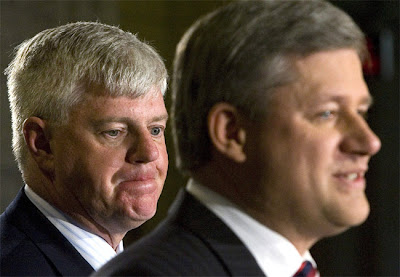
True Colours: Manley takes helm of Canadian Council of Chief Executives


Tuesday, June 23, 2009
Ottawa was an active contributor to this outcome: Investors may pay stiff price for Manulife's pride

An obvious and wholly intended purpose of Flaherty's income trust policy was to make Canadians saving for retirement become more captive to the wares of Canada's large LifeCos. Captive like sheep, to he herded and fleeced.
As such, Flaherty's idiot trust policy diverted investment AWAY from investment in Canada's real economy and INTO investments in synthetic products whose sole purpose is to generate fees for the life insurance industry. Look what happens when the imperative to drive earnings causes these life companies to take on unhedged risks, in the process.
A totally predictable outcome.....and completely lost on Canada's inept and incompetent Finance Minister and the Neanderthals working in the Department of Finance, including that Boy Wonder from Wall Street, Mark Carney. I wonder if AIG was ever a client of Mark's? Lehmann Brothers? Bear Stearns?
Investors may pay stiff price for Manulife's pride
Jun 23, 2009
James Daw
Toronto Star
The Book of Proverbs warns that "pride goes before destruction, a haughty spirit before a fall," but who knew what to expect from Manulife Financial?
Who recognized the trouble such a big, proud company could get its investors into by refusing to hedge or otherwise insure the capital and income guarantees it was providing to legions of stock and bond market investors in Canada, the United States and Japan.
The tentative conclusion reached by some leading class-action lawyers and investigators at the Ontario Securities Commission is that not enough of Manulife's stockholders knew ahead of time.
After coasting above the rest of the financial sector for much of last year, Manulife's stock price was slashed in half in the final quarter. It had to draw down a $3 billion loan.
Analysts started asking about its hedging practices and whether it needed to raise more capital.
Then came billion-dollar losses in its latest two financial quarters.
While the index of financial service stocks is now roughly back where it was a year ago, Manulife's stock is still down about 40 per cent.
Now the company has revealed the Ontario Securities Commission is questioning whether it provided investors with adequate disclosure but has yet to decide whether to take enforcement action.
Siskind, Cromarty, Ivey & Dowler LLP of London, Ont., has announced it is investigating a potential class-action lawsuit on behalf of investors who bought shares between Jan. 26, 2004 and March 26, 2009, when Manulife released its year-end results.
Manulife is not saying much at this point, except that it believes that its disclosure satisfied applicable requirements. Spokesman David Paterson declined yesterday to point to where and how the company warned of the potential risk for investors.
Clearly, various experts were well aware that Manulife was taking on considerable risk as its sales of so-called guaranteed living benefits or variable annuities soared over the past few years.
While consulting to Manulife, Moshe Milevsky, of York University's Schulich School of Business, began urging financial advisers, starting in 2007, to ask how companies were hedging those guarantees.
"I am simply arguing that the living benefits arms race is leading to promises and guarantees that might become difficult to keep," Milevsky wrote for Researchmag .com.
Brent Fullard, a lobbyist against changes in taxation of income trusts, raised such questions [in early 2007] as: "Whose credit risk are your investors exposed to? Yours or somebody else's? Where is this disclosed in your advertising? How do you provide your Income Plus investors with ongoing reporting of this shifting risk aspect of your product over time?"
But one of the earliest to warn insurers they should be properly hedging the risk of a stock market crash, or a 10-year period of low or negative returns, was Mary Hardy, a Waterloo professor of actuarial science.
The author of the 2003 instructional text for actuaries, Investment Guarantees, says her research pointed to the need for hedging but Manulife was openly opposed to the idea and argued publicly about why she and a fellow researcher were wrong.
"There is nothing you can throw at a hedging plan that makes it more risky than not hedging," Hardy insists.
Manulife relied instead on having enough of its own capital – or more properly, its investors' capital – to back its promises.
Hardy says that approach is not without cost, and waiting to put hedges in place while stock markets are falling, is even more expensive.
Siskind lawyer Dimitri Lascaris says it's not enough that experts knew the risk Manulife faced: "Disclosure of public corporations is not intended to be something only elite investors can understand."
jdaw@thestar.ca
Monday, June 22, 2009
Manulife faces possible class action lawsuit, concerning matters I first raised over two years ago
Today we learn that Manulife is facing the possibility of a billion dollar class action lawsuit from its shareholders, according to the Financial Post.
In the recent past, Manulife has gone to great lengths to position itself as a paragon of all things great, corporately speaking. It is anything but. Meanwhile the much vaunted corporate model has taken a credibility beating of its own.
The real world stress test of the last nine months have proven Manulife to be anything but a paragon of corporate virtue, and make it a perfect case study for Roger Martin’s theory that the global financial meltdown was brought about through improper compensation schemes for corporate managers that reward them for taking too many risks and taking the wrong risks. He is calling for the abolishment of stock options. Personally I wouldn’t go that far, however I am calling for the abolishment of the favorable tax treatment of employee stock options gains. Arbitrarily taxing these gains at half the rate of employment income is something is grossly unfair to all taxpayers and is rewarding the very behaviour that brought about the global financial meltdown and the multitude of taxpayer bailouts caused by it (like ABCP).
The global financial meltdown exposed the weaknesses of Manulife’s business model, that saw the company’s stock lose 75% of its value and require major infusions of capital to bolster its capital adequacy. Now we have the OSC launching an investigation of Manulife stating that the company failed to provide adequate disclosure on these matters that caused Manulife’s fall from grace, namely the issuance by Manulife of products like Income Plus and other variable rate annuities that it failed to hedge, and according to the OSC, that Manulife failed to disclose these inherent risks in its public disclosure documents.
It is good that the OSC is looking at this and the the head of OSFI recently made cautionary comments to the industry about this product line, however that’s not what’s needed here. The regulators can only regulate in the context of the legislation that they regulate. The life insurance industry has infected their main line business with the risks taken these types of new activities.....that Warren Buffett calls “crazy”. What would he say about those insurers like Manulife that didn’t even bother to hedge?
This is an issue that should be pursued by the lawmakers in Ottawa and new rules should be written and enforced to avoid these new systemic risks from new lines of business entering the main line business of life insurers, which is life insurance and not writing naked put options on the stock market, which is what maby of these products are the equivalent of, prompting Professor Kin Lo of the Sauder School of Business to observe:
"Insurance is about protecting people from risk and what we have seen is the insurance industry going out and seeking risk."
I was raising these very issues over two years ago, when the CEO of Manulife was before Parliament on February 1, 2007 giving testimony and calling for the abolishment of income trusts, and which incidentally would serve to bolster the sales of variable rate annuities by life insurers like Manulife. Unlike the MPs on the Finance Committee, my focus was on what these statements meant for Manulife rather than income trusts, and the risks that these products would bring to Manulife. On that date, I wrote an email entitled Questions for Mr Manulife, that read:
“What is the capacity of the Canadian banking system to provide you with swap arrangements that enable Manulife to offload the risk associated with this [type of variable rate annuity] product? Is this a profitable line of business for the banks? Whose credit risk are your investors exposed to? Yours or somebody else’s? Where is this disclosed in your advertising? How do you provide your Income Plus investors with on-going reporting of this shifting risk aspect of your product over time?”
These matters are now the subject of the OSC investigation that was announced on Friday and which we learn today may become the subject of a class action lawsuit
Meanwhile on the question of capital adequacy, the CEO of Manulife gave testimony on February 1 at the Public Hearings , where he was making a big deal about the great virtues of the corporate model versus the income trust model and the need to retain capital and have access to capital. On that day, I responded by asking the question at the time of “Are you saying that your capital adequacy ratios are insufficient and need to be raised to better protect your policyholders” and blogged the following question on May 4, 2007, and facetiously asked “ Are you saying that Manulife needs to increase its Tier 1 and Tier 2 capital adequacy?
I was more accurate in this suspicion than I had expected, as the answer to that pertinent question became self evident over time, and Manulife’s capital proved to be inadequate for these risks that were being assumed by Manulife, and which were not being adequately disclosed to shareholders, according the OSC. Meanwhile these are questions I was asking over two years ago. Where were the regulators then? Where was Ottawa then?
The better question however, is where is Ottawa now?

Saturday, June 20, 2009
Ottawa's culture of secrecy: Hey, 4 out of 308 ain't bad?
In today's Toronto Star we learn about a culture of secrecy in Otttawa about spending by MPs that shatters any doubt about the self serving nature of our paid elected representatives.
How would you ever expect a politician holding and practising such values to care a wit about revealing the truth behind 18 pages of blacked out documents that caused Canadians to lose $35 billion, when these very same people are going to absurd lengths to hide their own spending of taxpayers’ money. This is wholly unacceptable, and yet standard operating procedure in self-serving Ottawa. Two word description: Public disgrace
Our MPs' spending secrets
Marlene Jennings, the MP for Notre-Dame-de-Grâce—Lachine, was one of only four parliamentarians who agreed to release her expense records.
How MP expenses are the most closely guarded secret on Parliament Hill.
Canada's 308 members of Parliament claim almost $128 million a year in personal and office expenses – spending that's risen 42% since 2000. But when the Star asked where the money was going, almost everyone refused to talk
Jun 20, 2009 04:30 AM
Allan Woods
OTTAWA BUREAU
Toronto Star
June 20, 2009
OTTAWA – Eleven dollars and 45 cents for computer mouse pads, telephone equipment worth $13, a $15 rug and a $10,203 bill to move an MP's Parliament Hill office 37 steps, from one side of a stairwell to the other.
That is about all that's known of the almost $128 million in expenses claimed by federal politicians in the last fiscal year.
The rest of it – the mundane, the understandable and the exorbitant – may never be revealed thanks to a culture of secrecy on Parliament Hill that appears to have bled across partisan lines.
Twenty cabinet ministers and backbenchers resigned or will retire in Britain after a newspaper was handed a computer disc containing expense claims on everything from a moat-cleaning service to the rental of a dirty movie. A heavily censored version of all British MPs' expenses for the past three years was released on a parliamentary website this week and Scotland Yard launched a criminal investigation into some claims yesterday.
The House of Representatives in Washington now plans to post members' expenses online each quarter, and similar pre-emptive plans are developing in New Zealand.
But nothing of that sort is likely to bring more transparency to Ottawa. In Canada, you can see how much of your money your MP has spent – an annual tally comes out each fall – but you have no right to learn how they spent it.
Of the 37 MPs contacted in the past several weeks, just four agreed to disclose the detailed information on specific expenses requested by the Toronto Star. A vast number simply ignored the appeal.
Then scripted responses began streaming in from politicians of all parties in the House of Commons.
"I would remind you that for expenses to be approved, receipts need to be submitted to the House of Commons," said Zachary Healy, a Conservative party spokesman. "Receipts have been provided for all expenses, and they have been disclosed according to the rules currently in place," said Karl Bélanger, the senior press secretary to NDP Leader Jack Layton.
"If an expense does not meet the guidelines ... it is refused," said an aide to Liberal MP Glen Pearson.
Even the Bloc Québécois, which said weeks ago that it had no fear of opening its expense claims for a look-see by the auditor general, dismissed requests for assistance and transparency.
"Alors bonne chance," said Karyne Duplessis Piché, media relations officer for the Bloc caucus.
A secretive and powerful committee of eight MPs – four each from the government and the opposition – keeps watch over their colleagues' bills.
The Board of Internal Economy meets every few weeks behind closed doors to decide how a portion of taxpayers' money is spent running the House of Commons and compensating elected officials.
On March 9, they agreed to cover the legal expenses for six lawsuits brought against MPs for defamation, libel and employment disputes. They approved an out-of-court settlement to clear up another case involving an unnamed politician. The only public record of the payout is two lines in an obscure summary of the meeting.
The board won't say who's being sued, what prompted the lawsuit or how much the legal defences are costing taxpayers.
"At some point here there has to be some capacity to treat members in some confidence," said board spokesman Mauril Bélanger, the Liberal MP for Ottawa-Vanier. "These are such matters."
It's much the same for expenses, though there is a list of rules to separate the legitimate claims from the frivolous. There are also audits and all-party oversight of the money.
Bélanger even appeared to take offence at suggestions the expense system was something less than fully transparent.
"Are you suggesting there are scandals in the House of Commons?" the veteran MP asked. "I'm suggesting there aren't any ... I would argue, sir, that the level of scrutiny that is currently applied ensures that things that may have happened elsewhere are not happening here."
Don Boudria, a Liberal MP from 1984 to 2006 who also sat on the board, said federal politicians need discretion to manage staff salaries, office rentals and other purchases that make representing a constituency "like a miniature business."
But the checks and balances on MPs' expenses make Canada "a model that could be emulated in other countries," he added.
For now, Canadians have to trust that this is true. If someone objected to a decision made by the board, or even the secrecy surrounding how those decisions are made, there's not much they can do about it. The board has the final say on all of these matters – the judge, jury and court of appeal.
"They always say that the board meets in secret. Well, the boards of directors of most corporations meet privately also," said John Reynolds, a former Conservative MP who sat on the board for six years before he left politics ahead of the 2006 federal election.
"You can't run corporations that have public board meetings and the public attending your board meeting because you're talking about staff, you're talking about people."
Here's how the MPs' spending breaks down:
All expenses for the country's 308 MPs totalled $127,850,218 for the year ended March 31, 2008. That represents a jump of almost 42 per cent since the 2000-01 fiscal year, when 301 MPs spent $90,174,779.
The claims cover a politician's riding office, where there is an allotted amount that MPs can bill for expenses, staff, travel, advertising and building rental.
A second grouping of expenses covers goods and services provided by the Commons for an MP's Parliament Hill office, including telephone, printing, office supplies and a $5,000 fund for furniture and equipment improvement.
The different budget allotments are strictly administered, meaning MPs cannot use money set aside for travel between Ottawa and their constituency to buy fancy suits, Boudria said.
"You can't do that even if you didn't travel all year ... You'd send it in and it would be sent back."
The Star sought a detailed list of the $707,135 in expenses for services provided by the House of Commons labelled in annual disclosure statements as "Other."
That category provides MPs the widest latitude in spending and provides the greatest variance on spending.
In the 2007-08 fiscal year, the amounts billed ranged from $2 for Bloc Leader Gilles Duceppe, to $2,418 for Brampton Liberal MP Ruby Dhalla, to $17,910 for Helena Guergis, the Tory from Simcoe-Grey, to $314,542 for Winnipeg Conservative Steven Fletcher, who is paraplegic.
A few days after a reporter first placed telephone calls to a number of politicians, Liberal MPs alerted their whip, the person who makes sure all party members are operating in unison. The whip, Cape Breton MP Rodger Cuzner, promptly called the Star seeking more details about the request.
Cuzner said the rules surrounding expenses are one of the first things newly elected members are taught upon arrival in Ottawa.
To prove there are checks in place, he admitted that several of his own past expense claims have been denied or deemed improper.
Bélanger also said he had an advertising expense rejected because he had not included his constituency contact information in the publication. And as recently as March 26, the board rejected the claims of an MP who tried to expense child-care bills, according to a summary of the meeting.
Cuzner insisted that Liberals have nothing to hide, but added: "My reservation would be for individual MPs making their claims public when not everyone's is public."
He promised to "give it some thought" and try to find a way to help, but he never called back.
Only four MPs, all Liberals – Peter Milliken from Kingston, who is the Commons Speaker and the chair of the Board of Internal Economy, Jim Karygiannis, who represents the Toronto riding of Scarborough-Agincourt, former Liberal leader Stéphane Dion and Marlene Jennings from Montreal – agreed to release a breakdown of their expenses.
Milliken claimed the mouse pads and rental of an office water cooler at a cost of $176. Karygiannis billed for a $13 telephone cord. Dion claimed a $15 carpet during his brief stint as party leader.
Jennings was billed $3,404.30 by the House of Commons to physically move her Ottawa office 37 steps down the hall into an office vacated by former Toronto Liberal MP Bill Graham in early 2008. It cost $5,662.33 to paint the office and upholster two sofas, $836.44 for office repairs and $299.99 in information technology charges.
All the work was performed by government staff and the used furniture in her office was provided by the House of Commons, which automatically gives each item a monetary value, Jennings said.
The possible reasons MPs weren't more forthcoming are quite simple, according to a number of current and former officials.
First, there's no rule demanding that they do so. The bylaws state that only an MP or the board can authorize such a disclosure.
It's also nobody's business, said Reynolds, who retired from elected office in 2006 and now works in Vancouver as a strategic consultant with the Lang Michener law firm.
Making individual expense claims public, something already required of cabinet ministers and senior bureaucrats, only feeds a scandal-obsessed media, he said.
"I don't think it's important that somebody knows what somebody eats for their supper. It then becomes a story. So-and-so eats a steak and somebody else lives on a hamburger. ... There are people who like that stuff and that's why the National Enquirer sells so well."
But as with most bodies that conduct themselves far from public scrutiny, Bélanger said the board could decide at any time to shine more light on the hidden millions. Problems coming to light or scandals such as the one that continues to unfold in Britain could speed up that process. But then again, maybe not.
"Things have evolved over the past. I can't see why they wouldn't necessarily evolve over the future as well," Bélanger said.
"In what shape and at what rate? I can't predict that, but I can see things changing."

BNN: Copyright infringement, or a case of expunging the public record on Harper's income trust fraud?

This is absurd. BNN thinks that statements made on their public airwaves by Canada’s Minister of Finance and Opposition Party Finance Critic are subject to copyright protection? What a joke.....of a network.
Dear YouTube Member:
This is to notify you that we have removed or disabled access to the following material as a result of a third-party notification by Business News Network claiming that this material is infringing Copyright:
Flaherty explains why he won't change rules on Income Trusts: http://www.youtube.com/watch?v=WF_7ibAgYF0
John McCallum explains Liberal position on Income Trusts: http://www.youtube.com/watch?v=KATbsnjLVEA
Income Trust Tax Apologist: Gwyn Morgan / Part 1: http://www.youtube.com/watch?v=y4OupPiNwPE
Income Trust Tax Apologist: Gwyn Morgan / Part 2: http://www.youtube.com/watch?v=oZ-jO9q-DBc
The environment has now turned quite good for Private Equity: http://www.youtube.com/watch?v=UY6SKEVy7T0
Western Canadian speaks on Income Trusts and Stephen Harper: http://www.youtube.com/watch?v=F5eWedDfxok
Harper Decision hurts Alberta Royalty Trusts: http://www.youtube.com/watch?v=jtnkhkzqD6U
Friday, June 19, 2009
Income Plus. Disclosure Minus. Flaherty's favoured corp, favoured investment product gets enforcement notice

Manulife gets enforcement notice
Tara Perkins
Globe and Mail Update,
Friday, Jun. 19, 2009 06:25PM EDT
Manulife Financial Corp. (MFC-T23.250.200.87%) says it has received an enforcement notice from regulators who believe the company failed to make proper disclosures concerning certain exposures.
The insurer also said that its chief financial officer is retiring.
In a news release issued late on Friday, Manulife said that staff of the Ontario Securities Commission sent it a notice this week relating to the information it disclosed about its variable annuity and segregated funds business before March of this year.
Manulife says it believes that its disclosure met all of the requirements, but the preliminary conclusion of OSC staff is that the company failed to meet its continuous disclosure obligations related to its stock market exposure.
The market exposure stems from the company's large variable annuity and segregated funds business. The products are like private pension plans for individual investors. Manulife takes a customer's money, invests it, and promises payments down the road. When markets drop, it must build up capital and reserves to protect against any shortfall in the amount it has promised to pay customers in the future.
The company will now have the opportunity to respond to the OSC's notice before the regulator's staff decides whether to start proceedings. Manulife said it intends to co-operate with the OSC.
In a separate statement that the company characterized as unrelated, Manulife said that chief financial officer Peter Rubenovitch is retiring after 14 years, and will be replaced by Michael Bell, who has been the chief financial officer of Cigna Corp. (CI-N25.241.586.68%) for the past six years.
Ottawa sees to it that Canadians forfeit more of their rights and freedoms.

Today’s Ottawa Citizen: MPs recommend random roadside breath tests
A parliamentary committee has recommended that police officers be given the power to conduct random roadside breath tests on drivers, a change that would remove the legal requirement for officers to have a "reasonable" suspicion that drivers are drunk.
Today’s Toronto Star: Will police get easier access to emails?
Canada's police and security forces would get greater access to the Internet and wireless telecommunications records of millions of Canadians under a bill tabled yesterday by the federal Conservatives.


